Two deadly mushrooms, two seasons: When and where Marin dogs face the most risk
If outside the area, please call your nearest emergency vet.
Keeping your dog safe is part of every walk, whether you're exploring a trail or stepping into your own backyard. Some hazards are easier to spot than others. Death cap and western destroying angel mushrooms grow in Marin County, and their different seasonal peaks mean there's more than one time of year to watch for them.
To help you understand where and when these mushrooms have been found, we analyzed local sightings reported to iNaturalist and compared their locations with Marin County's detailed vegetation map. The records show monthly patterns and sightings near homes as well as in wooded areas. Here's what we learned and what it means for caring for your dog throughout the year.
Key takeaways
- Marin's deadly mushroom risk shifts with the season: 82% of death cap sightings occur from November through January, while 74% of destroying angel sightings occur from January through April.
- Oak woodland covers 6% of Marin's land but accounts for 26% of its deadly mushroom sightings.
- Deadly mushrooms aren't limited to Marin's wild spaces: 1 in 6 sightings occurred near homes.
Why these mushrooms are so dangerous to dogs
Death caps and destroying angels are among the deadliest mushrooms in the world, and a dog doesn't need to eat much for a walk to become an emergency. The danger is also easy to miss, because the warning signs don't show up right away.
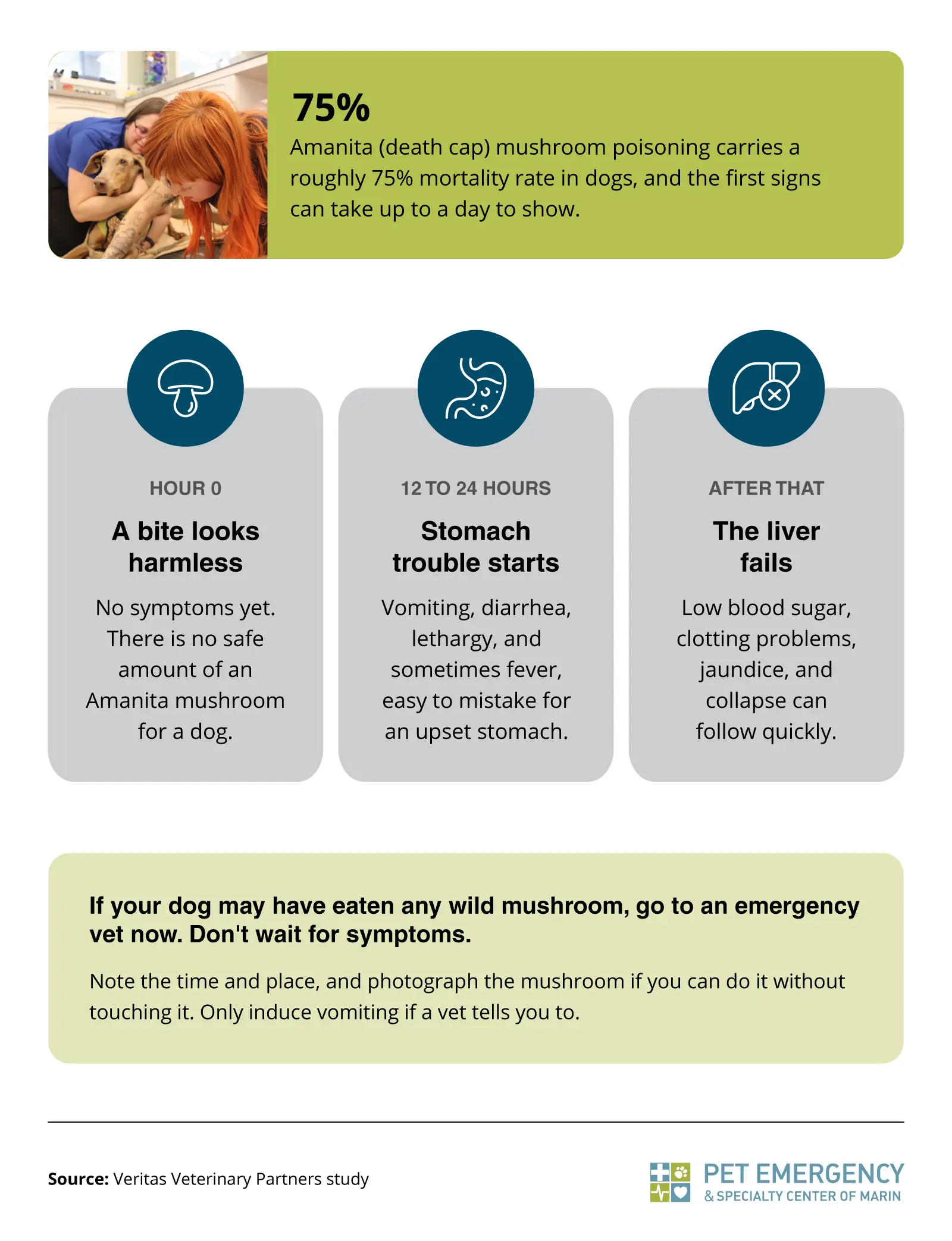
Amanita (death cap) poisoning carries a roughly 75% mortality rate in dogs. Symptoms usually appear 12 to 24 hours after a dog eats one. Owners shouldn't wait for signs before taking their pet to an emergency vet.
Where Marin's deadly mushrooms grow
These mushrooms don't grow evenly across the county, they grow in certain kinds of woodland. Matching sighting locations to the county's detailed vegetation map shows where sightings are most concentrated.
Oak woodland covers 6% of Marin's land but accounts for 26% of its deadly mushroom sightings. Add bay laurel woodland and the pattern is clearer. Together, oak and bay laurel cover about 1 in 5 acres in Marin but account for half of all sightings.
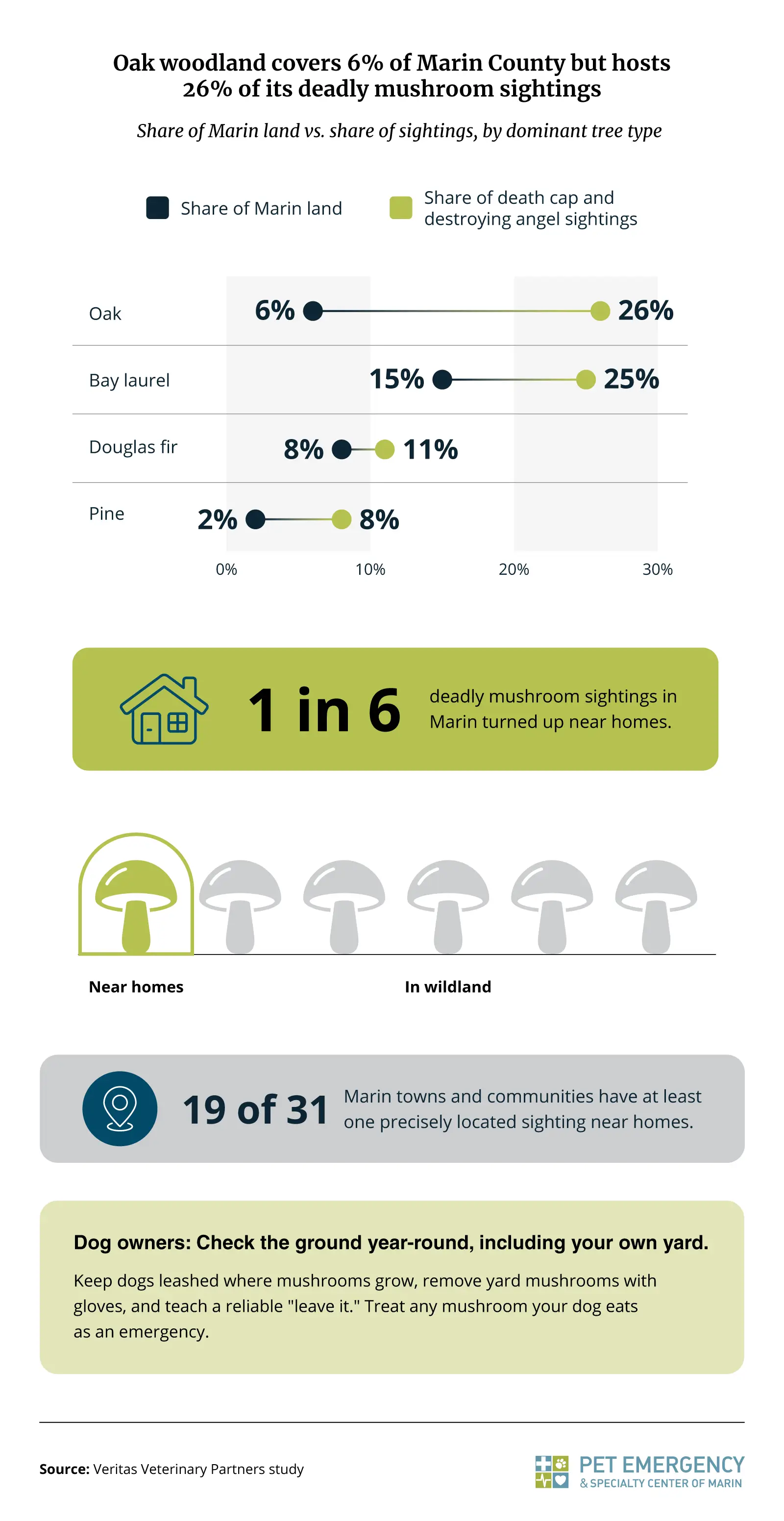
It's easy to think of these mushrooms as a backcountry problem, something to watch for on a hillside hike. The sighting records show a different picture.
One in 6 deadly mushroom sightings in Marin turned up near homes. Of the county’s 31 towns and communities, 19 had at least one sighting near homes. A yard, street, or neighborhood path can carry risk in addition to a trailhead.
Marin dog owners should be extra cautious from fall through spring
The risk in Marin doesn't follow a single season. It runs from fall into spring because two different species take turns.
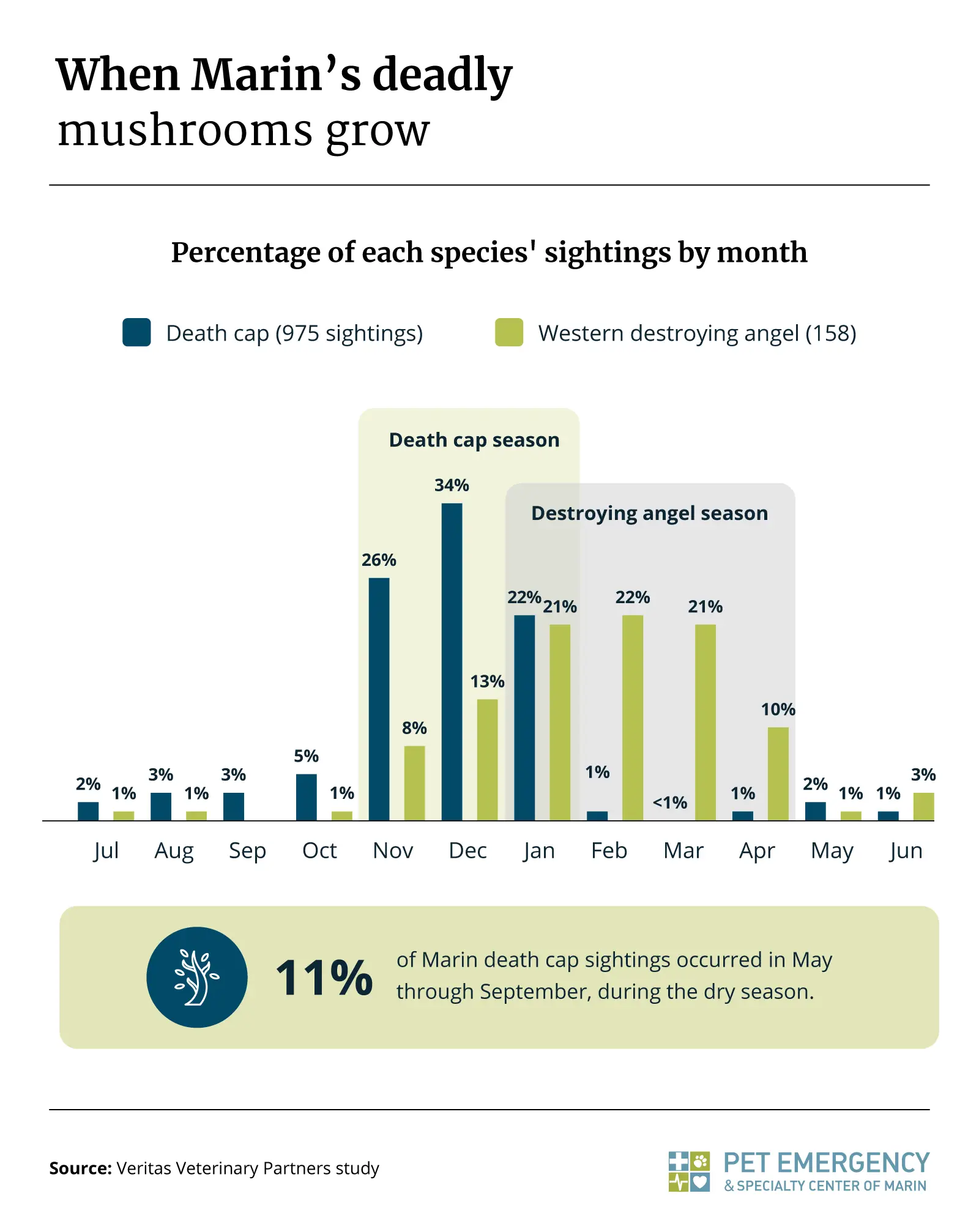
Most death cap sightings (82%) occurred from November through January, and 74% of destroying angel sightings happened from January through April. Death caps peak in December (34% of sightings) and drop to 1% in February, just as destroying angels hold steady at 21% to 22% a month from January through March.
Protecting your dog through every season
Knowing when and where deadly mushrooms have been spotted can help you stay alert, but sightings don't capture every place your dog could encounter one. Make checking your yard and watching for mushrooms on walks part of your routine, with extra care from fall through spring. If you think your dog may have eaten a wild mushroom, contact an emergency veterinarian right away, even if your dog seems well.
Methodology
To explore Marin County's risk of deadly mushrooms, we analyzed sightings of two species dangerous to dogs: the death cap (Amanita phalloides) and the western destroying angel (Amanita ocreata). We pulled observations of both species in Marin County from iNaturalist, a public community science platform where people log and identify what they find. Data were collected in October 2026 and may change as more sightings are reported. Our data cover 2009 to 2026. We removed 31 sightings whose locations were hidden by the observer, leaving 975 death cap and 158 western destroying angel sightings for the seasonal analysis.
To understand when the risk occurs, we grouped sightings by the month they were observed. We then calculated each species' share of sightings by month. This showed when death caps and destroying angels each peak, and how many sightings fall outside the rainy season.
To understand where the risk occurs, we limited the analysis to the 716 sightings with GPS accuracy within 100 meters and matched each one to the Marin Countywide Fine-Scale Vegetation Map (2021), produced by the Tamalpais Lands Collaborative (One Tam) and the Golden Gate National Parks Conservancy. We assigned each sighting the dominant mapped vegetation at its location, then compared each habitat's share of Marin's land (excluding open water) with its share of sightings. We classified a sighting as near homes if it fell in land the map identifies as developed or containing buildings, then counted how many of Marin's 31 incorporated towns and Census-designated communities had at least one.
Limitations: iNaturalist sightings are reported by the public, so they reflect where and when people look as well as where mushrooms grow. Areas with more foot traffic may be overrepresented, and the absence of a sighting doesn't mean a location is safe. Some identifications, particularly of destroying angels, have not been confirmed by the iNaturalist community. The vegetation map has an overall accuracy of 77% and records only the dominant vegetation in each area, so individual trees, including oaks in yards, may not be captured.
About Pet Emergency & Specialty Center of Marin
Pet Emergency & Specialty Center of Marin is a 24/7 emergency and specialty veterinary hospital, providing advanced, collaborative care around the clock in the Bay Area. Our board-certified specialists and emergency clinicians work together across disciplines to deliver the highest level of medicine for pets facing complex or urgent medical situations. If you ever face a pet emergency, we're here to help.
Fair use statement
This content is free to share for noncommercial purposes. We just ask that you credit Pet Emergency & Specialty Center of Marin and link back to us when doing so.
The information contained in the article is for informational purposes only and is not intended to take the place of the advice of a veterinarian.