2026 breed risk report: The pets most likely to need emergency care in California and Marin County
If outside the area, please call your nearest emergency vet.
In a survey of 300 California dog and cat owners, including 114 from Marin County and the surrounding Bay Area, more than half (53%) couldn't confidently name their pet's single biggest breed-related health risk. Pet Emergency & Specialty Center of Marin ran the survey to find out how well owners understand those risks and how prepared they are when a pet ends up in the emergency room.
Throughout this report, figures describe all 300 California respondents unless a Marin comparison is stated. Where Marin residents are called out separately, that subset is 114 respondents.
Most owners are less prepared than they think, with most owners reporting their pet has already made an emergency visit. Preparing for the next one doesn't take much, and knowing your pet's specific risks is the first step.
Key takeaways
- Chihuahuas (72%) and mixed-breed dogs (71%) are Marin's most emergency-prone pets.
- The Golden Retriever is the Bay Area's most popular dog breed, and the largest U.S. study of the breed has logged more than 1,700 cancer diagnoses in 3,000 dogs.
- Flat-faced pets' emergencies escalate into specialty care at 57%, vs. 33% for other pets.
- Persian cat owners are the least sure of their breed's risks, with 74% unable to name its biggest one.
- 57% of owners surveyed say their pets have already had an emergency visit.
- Urinary blockages drove nearly 1 in 4 cat ER trips (24%).
- 72% of owners have no money set aside, and 44% have delayed care over cost.
- Marin owners hold the financial edge, with 33% unable to cover a $1,000 emergency without going into debt vs. 47% in the rest of the state.
Even attentive owners are missing their pet's biggest risks
Owners were confident about pet care in general, but far less sure about the specific health risks their pet's breed carries.
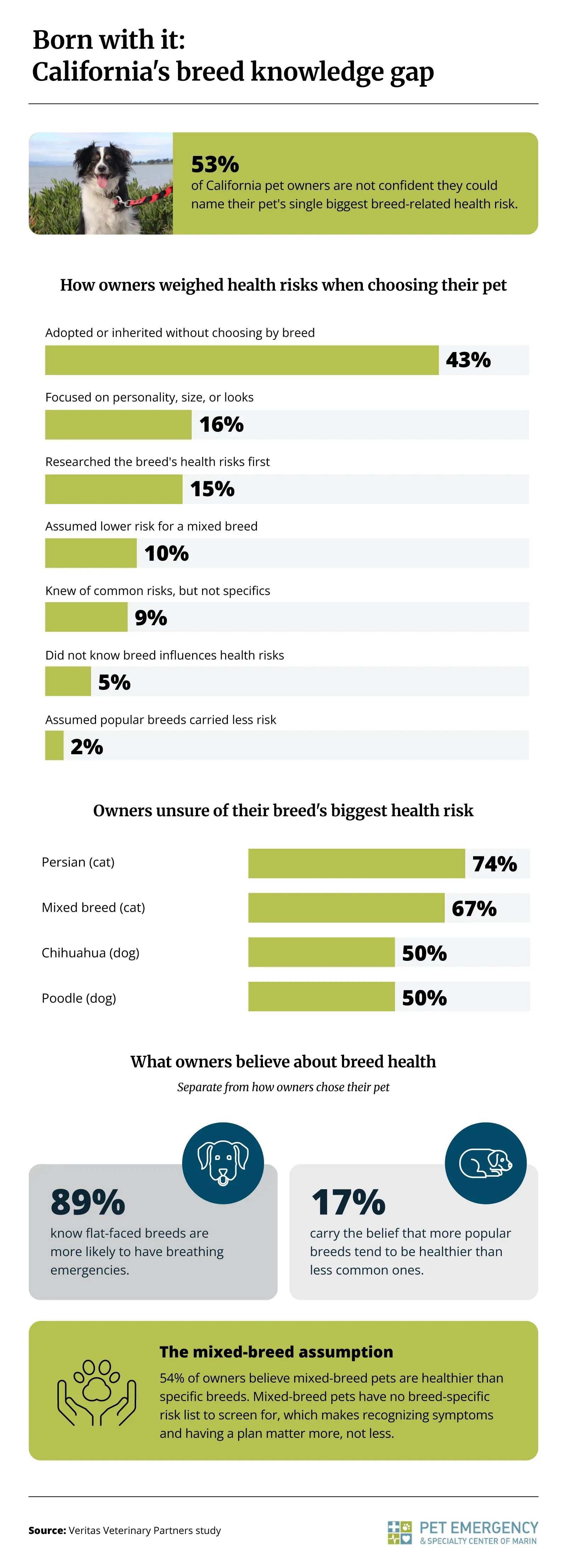
More than half of owners (53%) couldn't confidently name their pet's single biggest breed-related health risk; 13% were very confident, 34% somewhat, 29% not very, and 24% not at all. Marin owners edged out the rest of the state on overall confidence, with 47% of them not confident compared to 56%.
The path into ownership helps explain part of this missing knowledge, since 43% adopted or inherited their pet without choosing by breed, and only 15% researched a breed's health risks first.
Owners had absorbed some fundamentals, with 89% aware that flat-faced breeds are at higher risk of breathing problems. Nationwide's analysis of more than 50,000 brachycephalic dogs found flat-faced dogs nearly three times as likely to file a breathing-problem claim. More than half (54%) also thought mixed breeds are healthier than specific breeds. On a separate question about belief rather than about how they chose, 17% agreed that more popular breeds tend to be healthier. Marin residents were more likely to agree than other Californians (25% vs. 11%).
Cats owned the uncertainty rankings outright. Persian owners (74%) and mixed-breed cat owners (67%) topped the list of the least sure. Mixed-breed cats here include Domestic Shorthairs and Domestic Longhairs, the standard terms for cats without a specific documented breed, alongside owners who described their cat as a mix. Overall, cat owners were more likely than dog owners to be unsure of their pet's biggest health risk (65% vs. 43%).
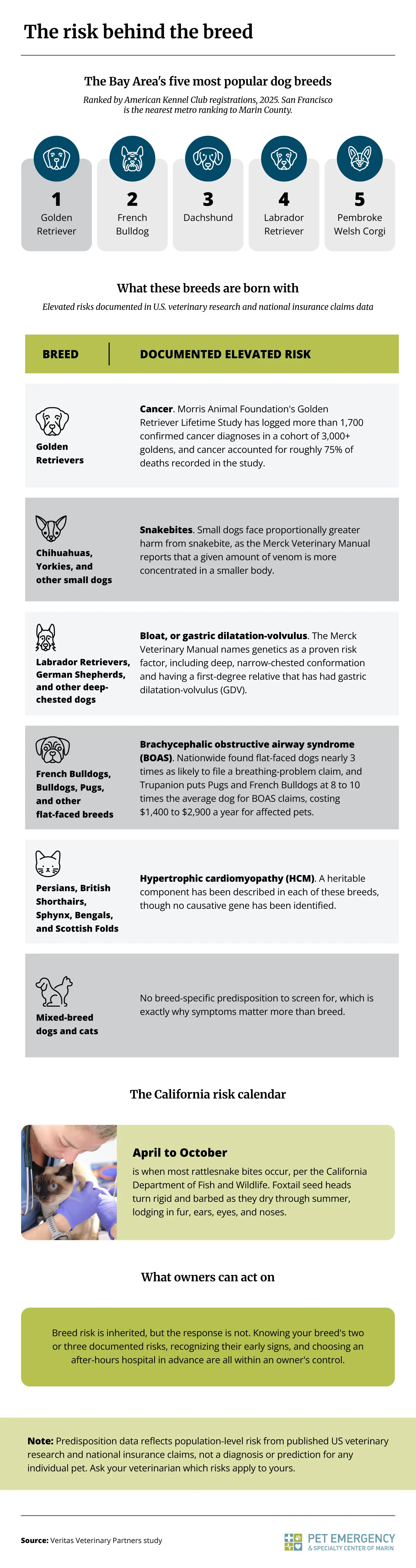
The American Kennel Club's (AKC) 2025 registrations rank the Golden Retriever, French Bulldog, Dachshund, Labrador Retriever, and Pembroke Welsh Corgi as San Francisco's five most popular dog breeds, the nearest metro ranking to Marin. The Golden is the most intensively studied cancer breed in the country. The Golden Retriever Lifetime Study has logged more than 1,700 confirmed cancer diagnoses among its 3,000-plus goldens, with cancer accounting for roughly 75% of deaths recorded.
As for deep-chested dogs, the Merck Veterinary Manual lists German Shepherds among the breeds at risk of bloat, and the American College of Veterinary Surgeons (ACVS) notes preventive gastropexy can be performed during a spay or neuter for at-risk breeds.
In Marin and the North Bay, the California Department of Fish and Wildlife reports most rattlesnake bites occur between April and October. For smaller dogs, snakebites pose a greater threat. According to another Merck report, the venom from these bites is more concentrated in a smaller body and could be fatal.
On the cat side, Persians are among the breeds with a described heritable component for hypertrophic cardiomyopathy (HCM), and Maine Coons and Ragdolls are the only two cat breeds with identified causative MYBPC3 mutations for it.
Chihuahuas and mixed-breed dogs lead the emergency list
For most surveyed pets, the emergency room was already part of their medical history.
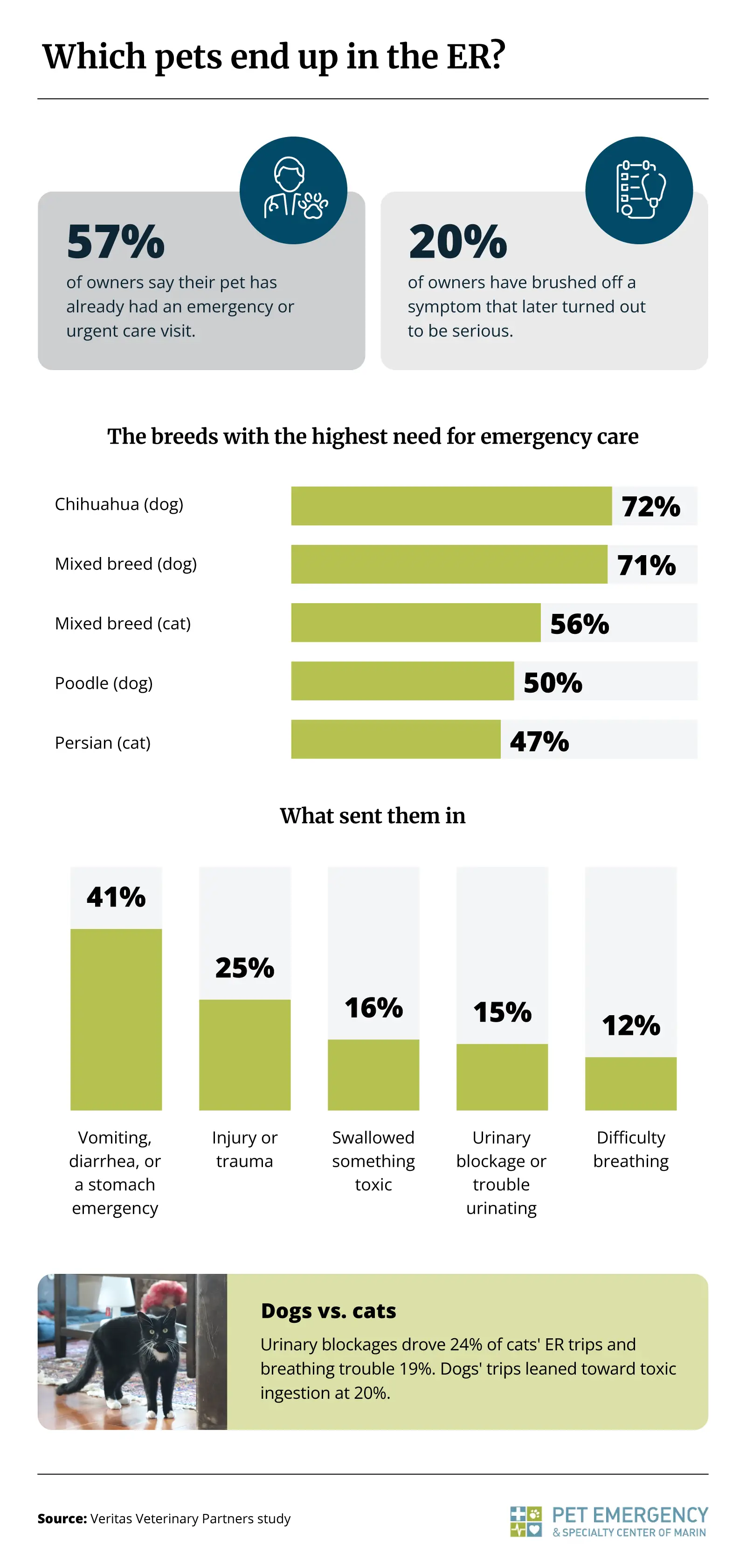
A majority of owners (57%) said their pet has already made an emergency or urgent-care visit. Stomach emergencies led at 41% of those trips, followed by injury or trauma (25%), toxic ingestion (16%), urinary blockages (15%), breathing trouble (12%), and severe allergic reactions (12%).
According to their owners, Chihuahuas (72%) and mixed-breed dogs (71%) led the emergency ranking, and mixed-breed cats visited the ER more often than pedigreed cats (56% vs. 48%). Species steered the causes. Urinary blockages drove nearly 1 in 4 cat ER trips (24%) and breathing trouble 19%, while dogs leaned toward toxic ingestion at 20%.
Age told its usual story, with senior pets at a 63% emergency rate versus 55% of adults and 31% of puppies and kittens. And while 20% of owners overall admitted brushing off a symptom that later turned serious, owners in the rest of the state did so at nearly twice the rate in Marin (24% vs. 13%).
Fleas and ticks top the worry list
The hazards on local owners' minds were less about the dramatic and more about the everyday.
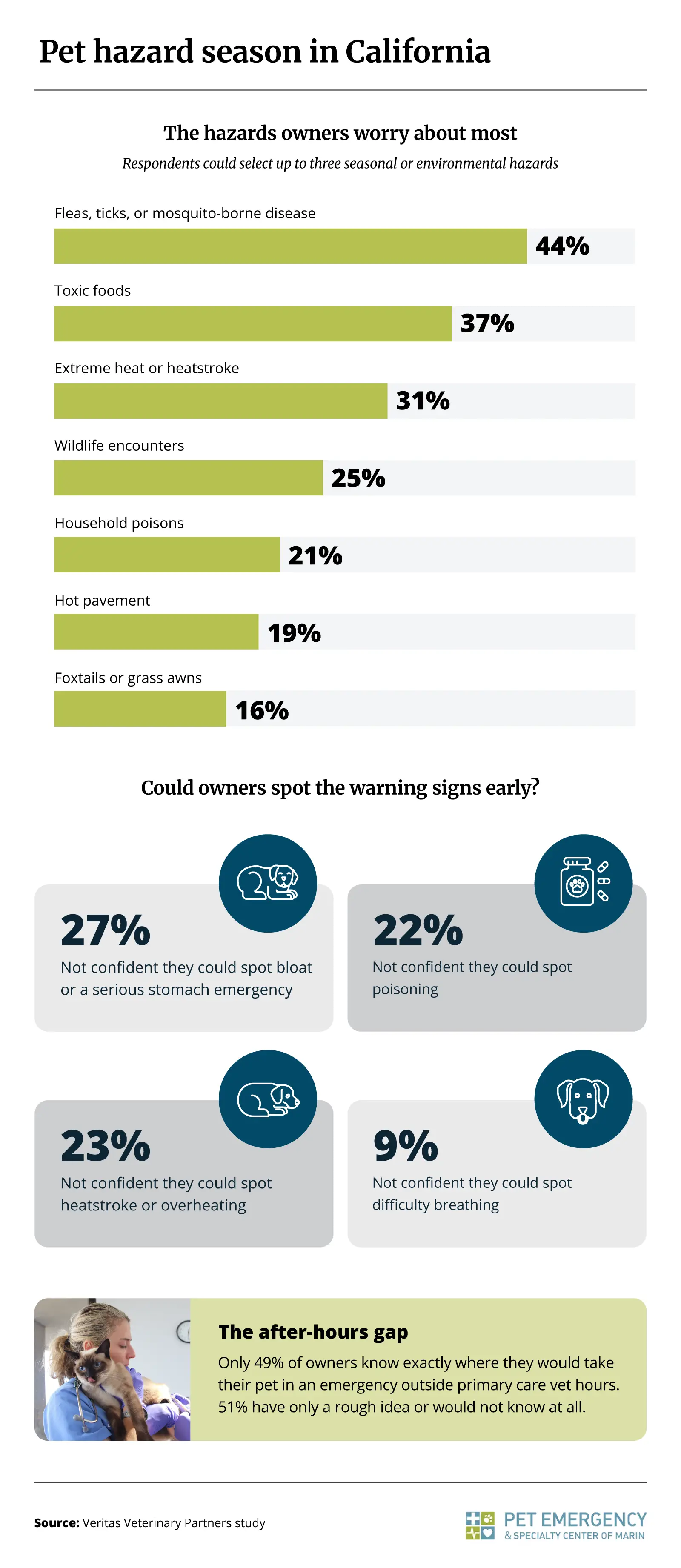
Fleas and ticks worried 44% of owners, ahead of toxic foods (37%), extreme heat (31%), and wildlife encounters (25%).Among Marin residents the order shifted, with toxic foods leading at 36%, fleas and ticks at 35%, and wildlife at 26%.
About a quarter of owners (27%) weren't confident they could spot bloat early, with 23% saying the same for heatstroke and 22% for poisoning. Just under half (49%) knew exactly where they'd go in an after-hours emergency, 41% had a rough idea, and 10% wouldn't know.
When one ER visit needs a specialist
A meaningful share of emergencies required more than one specialist, and the finances weren't ready for them.
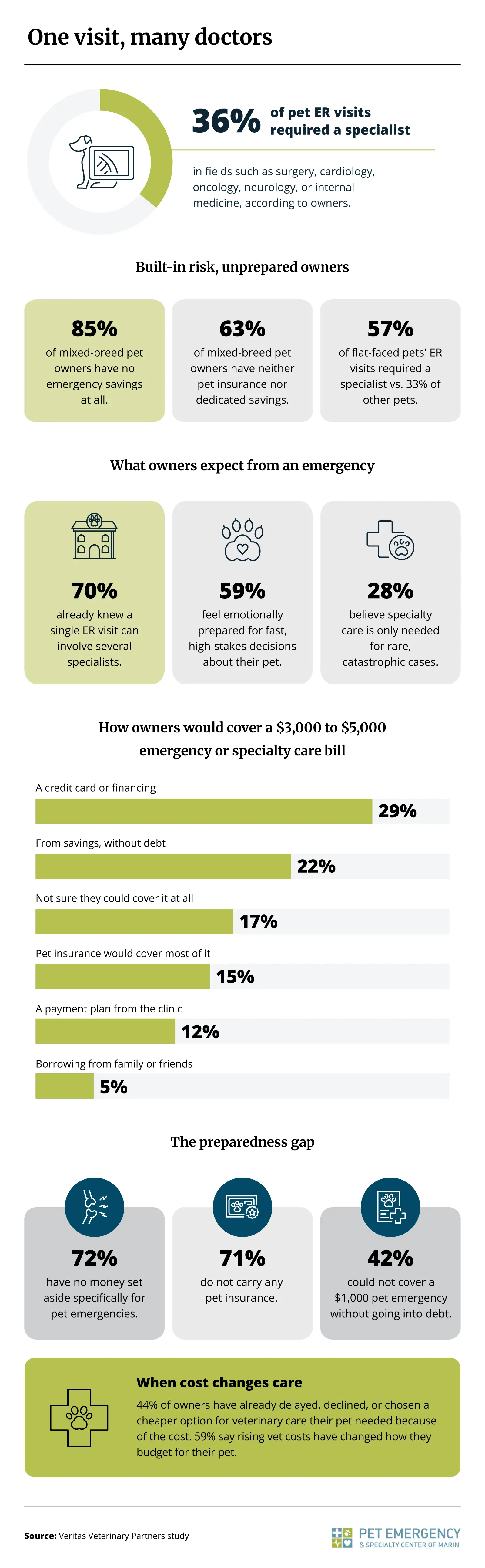
Among owners whose pet has been to the ER, just over a third (36%) said the visit required a specialist. Flat-faced pets were more likely to do so (57%) than other pets (33%). Most owners (70%) already knew that one visit can involve several specialists, and while 28% believed specialty care is only for rare catastrophes, 44% disagreed. About 59% felt emotionally prepared, and the same share said rising costs had changed their pet budget.
The financial picture varied by demographic:
- 72% of owners had no money set aside for pet emergencies. Some of them did carry pet insurance, which leaves 57% with neither a cushion nor a policy, falling to 49% among Marin residents.
- 57% of owners had neither money set aside nor pet insurance, compared to fewer Marin residents (49%).
- Mixed-breed pets were the least protected group: only 22% were insured, and 63% of their owners had neither insurance nor savings.
Advanced cases require advanced care, and that carries higher costs. A hospital staffed around the clock with board-certified specialists is a different operation from a primary care practice, with different equipment, staffing, and overnight capability. Take one of the most common stomach emergencies. Surgery to clear an intestinal blockage in a dog averages $5,842 in California, one of the highest figures in the country and well above the $4,383 national average, according to CareCredit, drawing on a 2025 Synchrony procedural cost study. For cats, foreign body removal averages $3,159 in the state. Those are cost-research figures, not pricing at any Veritas hospital. That's why we asked owners how they would pay a bill in that range, and even the band we asked about sits below what the average California case runs.
For a $3,000 to $5,000 emergency or specialty vet bill, 29% would use a credit card, 22% would use savings, and 15% would use insurance, while 17% weren't sure they could cover it. Cost had already affected pet care for 44% of owners, who had delayed, declined, or downgraded treatment because of it. Among owners earning under $25,000, 59% couldn't cover $1,000, compared with 22% earning $100,000 or more.
ASPCA reported this year that roughly six in 10 U.S. pet owners lack confidence they could afford a pet medical emergency, and a PetSmart Charities-Gallup study found 52% skipped needed care in the past year, close to the share here who delayed, declined, or downgraded treatment.
Getting ready for an emergency
The survey points to a few practical steps that make a difference before an emergency ever happens. Knowing your pet's specific breed risks helps, and so does treating subtle symptoms as worth a call rather than a wait. Picking an after-hours destination in advance means one less decision under pressure, since only 49% of owners currently know exactly where they would go. A financial plan matters just as much, and the earlier you start setting money aside or exploring insurance options, the more prepared you'll be.
Methodology
To explore how well pet owners understand their pets' breed-related health risks and how prepared they are for veterinary emergencies, we surveyed 300 California dog and cat owners via online survey panels from June 22 to July 14, 2026. Of these, 114 respondents (38%) lived in Marin County and in nearby Bay Area, and the remainder lived elsewhere in the state. These regions reflect the markets served by Pet Emergency & Specialty Center of Marin.
Respondents who owned more than one pet were asked to answer about the single pet they would be most worried about in a medical emergency. Among respondents, 56% answered about a dog and 44% about a cat; 57% were women, 43% were men, and 1% were non-binary. All respondents were adults ages 18 and older. By generation, 20% were Gen Z (ages 18 to 29), 46% were millennials (ages 30 to 45), 30% were Gen X (ages 46 to 61), and 4% were baby boomers (ages 62 and older).
Questions about the causes of emergency visits and the escalation to specialty care were asked only of the 170 respondents whose pet had experienced an emergency or urgent-care visit. Percentages for multi-select questions are based on all respondents shown the question and may total more than 100. All figures are rounded to the nearest whole percentage, so some totals may not equal 100.
This report also draws on published U.S. data. Breed commonality reflects American Kennel Club 2025 registration statistics for the San Francisco metro area, the nearest available ranking to Marin County. Breed predisposition figures come from Nationwide's analysis of more than 50,000 brachycephalic dogs; Trupanion claims data; Morris Animal Foundation's Golden Retriever Lifetime Study, an ongoing cohort of more than 3,000 dogs; the Merck Veterinary Manual; the American College of Veterinary Surgeons; the Dog Aging Project's analysis of 47,444 dogs; and published research on feline hypertrophic cardiomyopathy genetics. Seasonal and toxin figures come from ASPCA Poison Control's 2025 exposure data.
Emergency surgery costs come from CareCredit's published California averages, based on a 2025 Synchrony Average Procedural Cost Study conducted by ASQ360° Market Research, and are not pricing at Veritas hospitals.
Breed categories reflect what owners reported. "Specific-breed" means the owner identified a single breed rather than a mix; it does not imply registry documentation.
Affordability comparisons come from a 2026 ASPCA survey and the PetSmart Charities-Gallup State of Pet Care study. Predisposition data describes population-level risk, not a diagnosis or prediction for any individual pet. Rattlesnake season timing comes from the California Department of Fish and Wildlife.
About Pet Emergency & Specialty Center of Marin
Pet Emergency & Specialty Center of Marin is a 24/7 emergency and specialty veterinary hospital, providing advanced, collaborative care around the clock in the Bay Area. Our board-certified specialists and emergency clinicians work together across disciplines to deliver the highest level of medicine for pets facing complex or urgent medical situations. If you ever face a pet emergency, we're here to help.
Fair use statement
This content is free to share for noncommercial purposes. We just ask that you credit Pet Emergency & Specialty Center of Marin and link back to us when doing so.
The information contained in the article is for informational purposes only and is not intended to take the place of the advice of a veterinarian.