America's most pet emergency-prepared cities in 2026
If outside the area, please call your nearest emergency vet.
Where you live can affect the resources available when your pet needs emergency care. We compared 101 U.S. cities across five measures, including emergency veterinary listings, Google review ratings, natural disaster risk, veterinary workforce levels, and state pet ownership rates. Lexington, Kentucky, ranked first overall, while Virginia claimed three spots in the top 10. Several California cities finished at the bottom of the rankings.
We also surveyed 1,000 U.S. pet owners to assess their preparedness for a veterinary emergency. Their responses revealed gaps in identifying after-hours care, keeping emergency supplies ready, and knowing what to do when a pet needs urgent help.
Key takeaways
- Lexington, Kentucky, ranks as the most pet-emergency-prepared city.
- Bakersfield, California, ranks as the least pet-emergency-prepared city.
- Enterprise, Nevada, has the most emergency vet listings per capita, with 87.5 emergency vet listings per 100,000 residents.
- McKinney, Texas, has the highest-rated emergency vets, with an average Google rating of 4.78 stars.
- Nearly half of pet owners (45%) haven't identified a clinic that offers after-hours or overnight emergency care.
- Only 11% of pet owners have a go bag ready for their pet in case of an emergency.
Cities leading the national rankings in pet emergency preparedness
Pet emergency preparedness depends on more than the number of veterinary clinics in a city. The rankings below compare 101 cities across:
- Emergency vet access (emergency vets per 100K residents)
- Care quality (average Google rating of emergency vets)
- Vet workforce (veterinarians per 100K residents)
- Pet ownership (state pet ownership rate)
- Pet safety (based on FEMA natural disaster risk scores)
Search for your city to see how it ranks overall and which measures reveal local strengths or gaps in preparedness.
10 most prepared cities for pet emergencies
1 - Lexington, Kentucky
2 - Virginia Beach, Virginia
3 - Madison, Wisconsin
4 - Cincinnati, Ohio
5 - Richmond, Virginia
6 - Durham, North Carolina
7 - Arlington, Virginia
8 - Fort Wayne, Indiana
9 - St. Petersburg, Florida
10 - Kansas City, Missouri
10 least prepared cities for pet emergencies
101 - Bakersfield, California
100 - Stockton, California
99 - New York City, New York
98 - Los Angeles, California
97 - Chicago, Illinois
96 - Long Beach, California
95 - Fresno, California
94 - San Jose, California
93 - Riverside, California
92 - Chula Vista, California
Lexington leads overall and has the largest veterinary workforce per capita
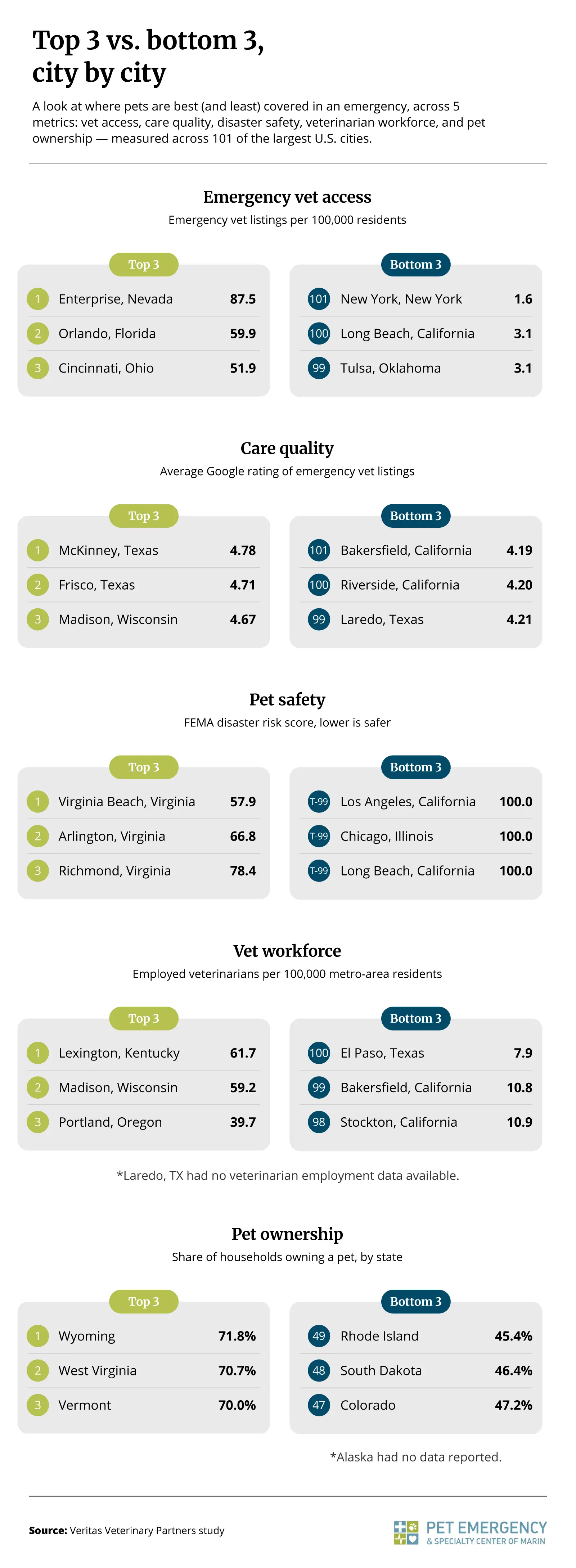
Lexington, Kentucky, ranked as the most pet-emergency-prepared city among the 101 U.S. cities studied. It also led for veterinary workforce, with 61.7 employed veterinarians per 100,000 metro-area residents.
Madison, Wisconsin, placed third overall and second for veterinary workforce, with 59.2 veterinarians per 100,000 metro-area residents. Cincinnati, Ohio, finished fourth overall and third for emergency veterinary listings per capita.
Virginia claims three spots in the top 10
Virginia Beach ranked second overall, Richmond placed fifth, and Arlington finished seventh. All three also led on the study's natural disaster risk measure, with Virginia Beach ranking first, Arlington second, and Richmond third based on FEMA scores for their matched county or county-equivalent areas.
California accounts for several of the lowest-ranked cities
Eight of the 10 lowest-ranked cities were in California, with Bakersfield placing last at 101st and Stockton at 100th. Both had comparatively small veterinary workforces, with 10.8 and 10.9 employed veterinarians per 100,000 metro-area residents, respectively.
The other California cities in the bottom 10 were Los Angeles (98th), Long Beach (96th), Fresno (95th), San Jose (94th), Riverside (93rd), and Chula Vista (92nd). Their individual results varied considerably. Riverside ranked 12th for emergency veterinary listings per capita but 100th for average Google review ratings, while Chula Vista placed 14th for veterinary workforce despite its low overall position.
New York City (99th) and Chicago (97th) were the only cities outside California in the bottom 10. New York had the lowest emergency veterinary listing rate, at 1.6 per 100,000 residents, reflecting listings relative to population rather than the total number of emergency facilities.
Where cities lead and lag in pet emergency preparedness
Different cities stood out depending on the measure, from emergency vet access in Nevada to review ratings in Texas. The comparisons below highlight differences in emergency veterinary listings, review ratings, disaster risk, and veterinary workforce, alongside state pet ownership rates.
Enterprise leads in emergency veterinary listings per capita
Enterprise, Nevada, had the highest emergency veterinary listing rate, with 87.5 listings per 100,000 city residents. These rates compare collected listings relative to population, rather than the total number of emergency facilities. Even Lexington, the overall winner, placed 48th on this measure, showing that a high overall ranking does not necessarily mean a city leads in every category.
McKinney and Frisco stand out for Google review ratings
McKinney, Texas, had the highest average Google rating for the collected listings, at 4.78 stars. Frisco, Texas, followed at 4.71 stars, giving Texas the top two spots on this measure.
Virginia cities lead on the disaster risk measure
Virginia Beach had the lowest FEMA natural disaster risk score among the places analyzed, at 57.9, followed by Arlington at 66.8 and Richmond at 78.4. Lower scores indicate lower relative disaster risk, putting these three Virginia cities at the top of this category.
What California's rankings mean for pet owners in the state
Several California cities ranked near the bottom overall, but each city’s results tell a more nuanced story. For example, Riverside ranked 12th for emergency veterinary listings per capita, while Chula Vista placed 14th for veterinary workforce. The overall scores combine these measures with Google ratings, regional disaster risk, and state pet ownership rates. They don't assess the clinical quality of any individual hospital.
For California pet owners, the findings reinforce the value of planning ahead: knowing where to find after-hours care, saving the hospital's contact information, and having a transportation plan ready.
Are pet owners ready for a veterinary emergency?
A veterinary emergency can happen unexpectedly. Here's how prepared they are to recognize it, afford it, and act fast.
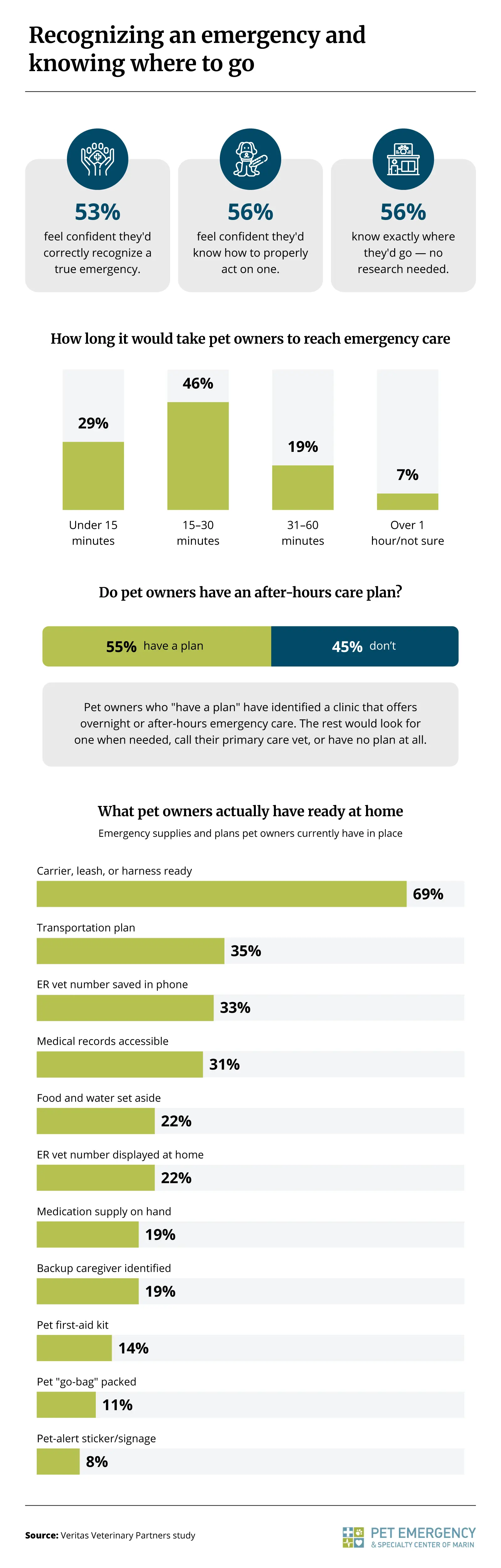
Just over half of surveyed owners felt ready to recognize and respond to an emergency: 53% were confident they could correctly identify a true veterinary emergency, and 56% were confident they would know how to act. The same share (56%) also said they knew exactly where they would go without needing to research a provider first.
Planning for a pet emergency could use improvement. While 55% of owners had identified a clinic that offers overnight or after-hours emergency care, 45% had not.
Most owners believed care was reasonably close:
- 29% estimated that they could reach an emergency facility in under 15 minutes.
- 46% said it would take 15 to 30 minutes.
- 19% expected a trip of 31 to 60 minutes.
- 7% anticipated more than an hour or were unsure.
Owners were most likely to have a carrier, leash, or harness ready, with 69% reporting so. Far fewer had a transportation plan (35%), an emergency veterinarian's number saved in their phone (33%), or accessible medical records (31%). Only 22% had food and water set aside, and the same percentage had an emergency veterinarian's number displayed at home. Just 11% had a go bag packed, and 11% had none of the listed supplies or plans.
Preparation starts before symptoms appear
Owners can reduce uncertainty by identifying a nearby after-hours clinic, saving its phone number and address, and keeping a carrier or leash where it can be reached quickly. A current medication list, accessible medical records, and a small go bag can prevent avoidable delays.
Financial preparation deserves the same attention. Even a modest dedicated fund, a clear payment plan, or an insurance policy can give families more options when treatment cannot wait.
Methodology
To determine America's most pet emergency-prepared cities, we analyzed 101 U.S. cities across five equally weighted metrics:
- Vet access measured emergency veterinary listings returned per 100,000 city residents, sourced from Google Maps. Google Maps search results may include businesses outside city boundaries and unrelated or non-emergency listings. These measures reflect the collected search results rather than a verified inventory of emergency veterinary providers.
- Care quality was measured by the average Google rating of those same listings.
- Pet safety used FEMA’s National Risk Index score for each city’s matched county or county-equivalent area. The index measures relative risk associated with 18 natural hazards, incorporating expected annual loss, social vulnerability, and community resilience. Risk scores were inverted so that lower disaster risk contributed to a higher preparedness score.
- Vet workforce measured employed veterinarians per 100,000 metro-area residents, using the U.S. Bureau of Labor Statistics Occupational Employment and Wage Statistics program. Cities within the same metropolitan area share the same workforce rate.
- Pet ownership measured the share of households owning a pet in each city’s state. Alaska had no data.
The five normalized metric scores, expressed on a 0–100 scale, were averaged into a composite score, with each metric contributing 20%. Where a source metric was unavailable, its normalized score was replaced with the median observed score for that metric across cities with available data. This applied to Laredo’s veterinary workforce and Anchorage’s and Washington, DC’s pet ownership. Missing raw values and corresponding category ranks remained N/A.
We also surveyed 1,000 U.S. pet owners. Respondents were 63.6% women, 34.5% men, 1.7% nonbinary, and 0.2% another gender identity, with a mean age of 41 (median: 39, range: 18–81) and median annual personal income of $52,000. At the total sample size of n=1,000, results have a margin of error of ±3.1 percentage points at the 95% confidence level.
Percentages are rounded. Some multi-select survey responses may total more than 100%. Google Maps listings and ratings describe the results captured for this study and may change over time. City rankings show relative conditions across the 101 places analyzed and do not predict the outcome of any individual veterinary emergency.
About Pet Emergency & Specialty Center of Marin
Pet Emergency & Specialty Center of Marin is a 24/7 emergency and specialty veterinary hospital, providing advanced, collaborative care around the clock in the Bay Area. Our board-certified specialists and emergency clinicians work together across disciplines to deliver the highest level of medicine for pets facing complex or urgent medical situations. If you ever face a pet emergency, we're here to help.
Fair use statement
This content is free to share for noncommercial purposes. We just ask that you credit Pet Emergency & Specialty Center of Marin and link back to us when doing so.
The information contained in the article is for informational purposes only and is not intended to take the place of the advice of a veterinarian.