The "Dr. Google" Pet Emergency Report: How Owners Search Before They Seek Care
If outside the area, please call your nearest emergency vet.
When something seems wrong with your pet, the instinct to search online is almost automatic. It's fast, it's free, and it feels like doing something useful while your brain is still catching up to what's happening. But that instinct can delay the care that actually matters, and in some cases, come with great costs.
This report by the Pet Emergency & Specialty Center of Marin includes results from a survey of 1,027 American pet owners, plus oversamples of 205 California residents and 68 Marin County and San Francisco residents. These owners were asked about how they handled the critical first moments of their most recent pet health scare.
Key takeaways
- Over 2 in 5 American pet owners (44%) either waited more than 3 hours or never contacted a veterinarian at all. Among those who waited 3 hours or longer, over half (59%) still required professional veterinary care.
- Nearly half of American pet owners (48%) turn to a screen before calling a vet when their pet shows sudden or concerning symptoms. Google is the top first response for 39%, outpacing calls to a primary care vet (26%).
- 1 in 3 American pet owners have used an AI chatbot instead of visiting a vet because of cost, yet only 1 in 10 trust AI pet health advice as much as a veterinarian's.
- Veterinarians appear to calm pet owners far more than search engines: 70% say they felt less anxious after consulting a vet, compared with 42% after Googling their pet's symptoms.
- 55% of after-hours pet emergencies start with a screen. Among those after-hours cases, 1 in 5 American pet owners did not know that 24/7 emergency veterinary hospitals existed in their area.
The 5-minute window
When a pet health scare hits, most owners have a decision to make in minutes. What they reach for first, a phone, a search bar, or a vet, shapes everything that follows.
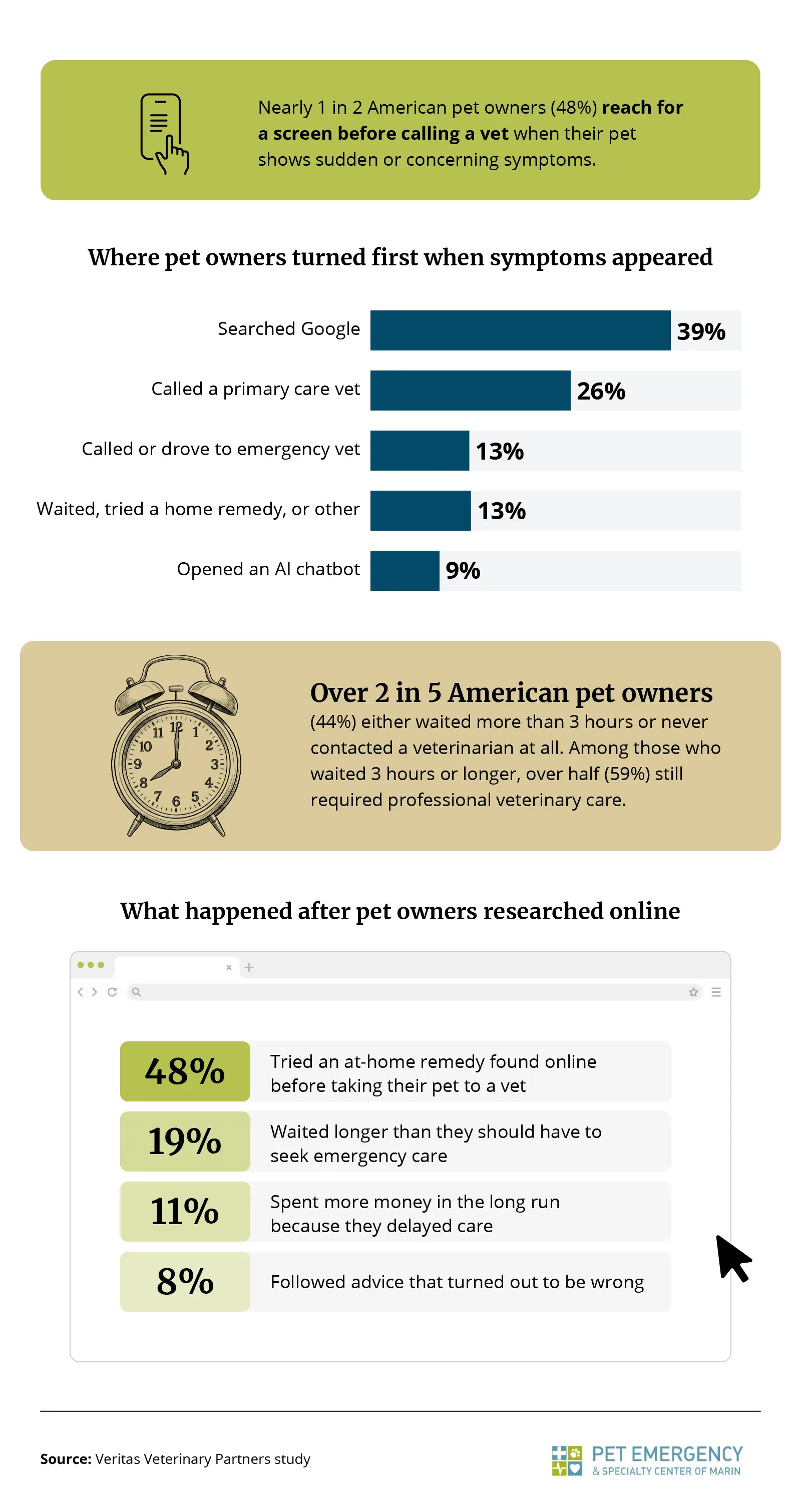
Nearly half of American pet owners (48%) said they reach for a screen before calling a vet when their pet shows sudden or concerning symptoms. Owners have most often turned to Google (39%), outpacing:
- Primary care vet (26%)
- Calling or driving directly to an emergency vet (13%)
- Waiting or trying a home remedy (13%)
Only 9% opened an AI chatbot as their very first move. Over 2 in 5 Gen Z owners (43%) turned to Reddit or an online forum during their most recent scare, compared to just 7% of baby boomers.
Gen Z pet owners were more than twice as likely as baby boomers to reach for a screen first during an emergency (61% vs. 29%). Over 1 in 2 baby boomer pet owners (52%) called a vet or drove to a hospital as their very first action. This likely reflects both greater comfort with direct contact and a longer history of knowing when something is serious.
Among pet owners who went online before contacting a vet, 34% cited cost concerns. Millennials were the most cost-driven at 35%, while baby boomers were the least (20%). Owners who have avoided contacting an emergency vet because of potential costs include:
- Pet owners with both dogs and cats (48%)
- Dog-only owners (40%)
- Cat-only owners (39%)
Among pet owners who researched online before seeking care, 48% tried an at-home remedy found online before taking their pet to a vet. Millennials were more likely to do this than baby boomers (52% vs. 35%). Overall, 19% of pet owners said they waited longer than they should have to seek emergency care, and 11% spent more money in the long run because they delayed care.
Another 8% of owners followed online pet health advice they later learned was inaccurate. More than 1 in 10 Gen Z (11%) did so, roughly three times the rate of baby boomers (4%).
After-hour emergencies
Over 1 in 2 after-hours pet emergencies start with an online search (55%). Women were more likely than men to turn to a screen first in after-hours situations (60% vs. 52%).
Among pet owners whose recent scare happened outside primary care vet hours, 22% searched online specifically because their vet was closed. And nearly 3 in 10 Gen Z pet owners (29%) didn't know that 24/7 emergency veterinary hospitals existed in their area, nearly double the rate of baby boomers (13%).
Over 2 in 5 American pet owners (44%) either waited more than 3 hours or never contacted a veterinarian at all. Among those who waited 3 hours or longer, over half (59%) still required professional veterinary care.
Zooming in on California
In California specifically, the patterns look similar to the national picture, with a few key shifts. Over 1 in 2 California pet owners (51%) reach for a screen before calling a vet when their pet shows sudden or concerning symptoms, with Google the first move for 41%, compared to just 22% who called their primary care vet. Over 1 in 2 California pet owners (53%) have tried an at-home remedy found online before taking their pet to a vet, and nearly 1 in 4 (23%) said they waited longer than they should have to seek emergency care. Over 2 in 5 (43%) have avoided taking their pet to an emergency vet because of cost, and more than 1 in 4 (27%) were not aware that 24/7 emergency veterinary hospitals existed in their area before taking this survey.
A closer look at Marin County and San Francisco
- 1 in 2 Marin and SF pet owners (50%) reach for a screen before calling a vet.
- Over 1 in 2 (51%) have tried an at-home remedy found online before taking their pet to a vet.
- Over 2 in 5 (46%) have avoided taking their pet to an emergency vet because of cost.
- Over 1 in 3 (37%) were not aware that 24/7 emergency veterinary hospitals existed in their area before taking this survey.
- Over 1 in 5 (21%) say delaying care because of online research cost them more money in the long run.
AI vs. the emergency vet
Artificial intelligence has entered the pet health conversation in a real way. But the data on whether it helps, or how much pet owners actually trust it, tells a more complicated story.
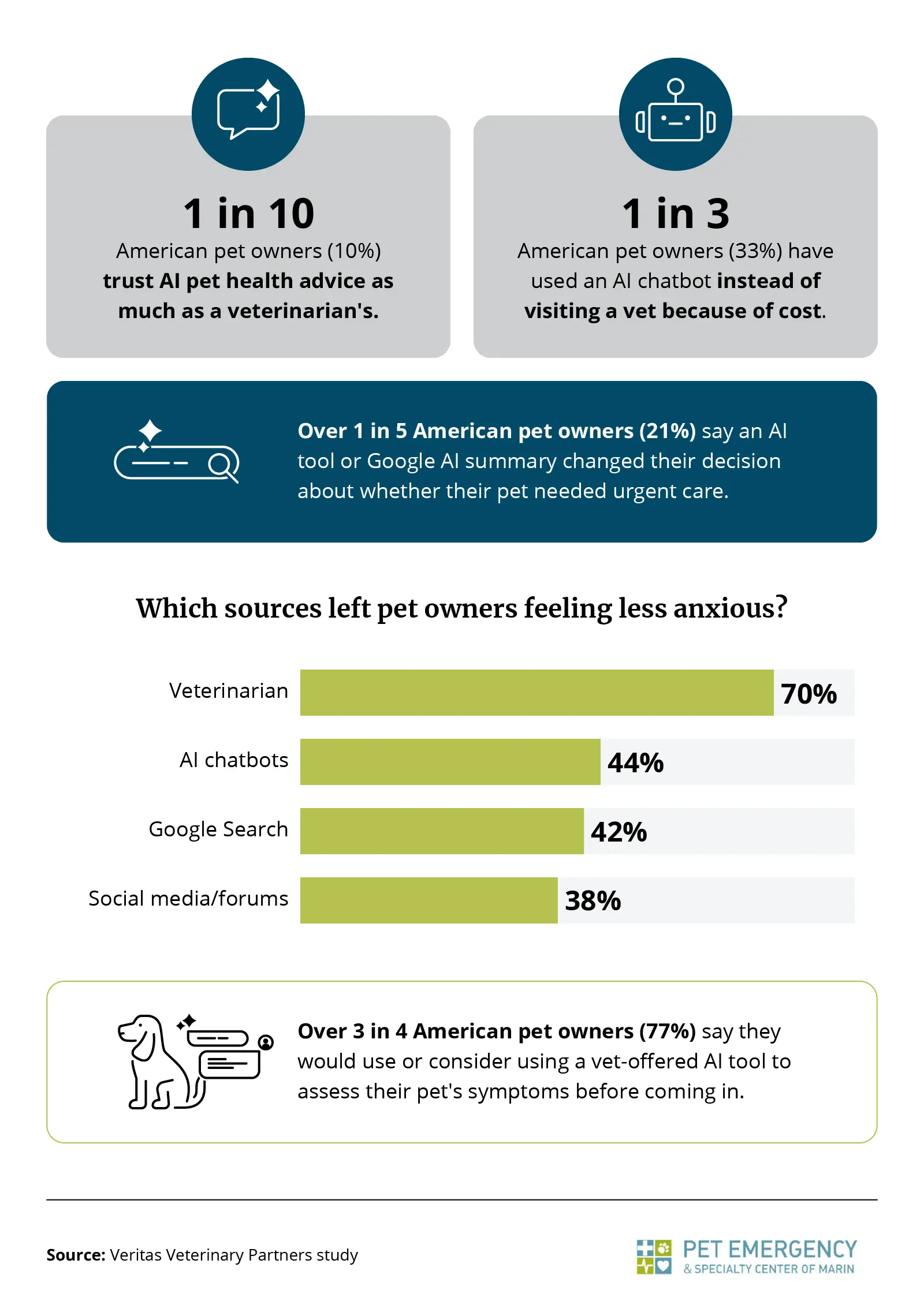
Over 1 in 5 American pet owners (21%) said an AI tool or Google AI summary changed their decision about whether their pet needed urgent care. One-third said they have used an AI chatbot instead of visiting a vet because of cost, but only 10% trust AI pet health advice as much as a veterinarian's.
The gap between use and trust is significant. People are turning to AI not because they believe in it, but because it's free and available at 2 a.m.
Gen Z leads AI adoption in this space, with 39% who used AI for pet health saying it changed their urgent care decisions. Gen Z owners were also the most likely to use an AI chatbot instead of visiting a vet because of cost (36%). And Gen Z owners who used Google during a health scare were the most likely to feel more anxious afterward (32%).
When it comes to which sources actually left pet owners feeling less anxious, vets came out on top by a wide margin:
- Veterinarian: 70%
- AI chatbots: 44%
- Google Search: 42%
- Social media and forums: 38%
American women who Googled their pet's symptoms were nearly 40% more likely than men to feel more anxious afterward (32% vs. 23%). Women were also more likely than men to call the vet for reassurance after that anxiety hit (46% vs. 38%) and to lose sleep or obsessively check on their pet (40% vs. 30%).
Over 2 in 5 Gen Z pet owners (43%) couldn't stop checking on their pet or lost sleep after a scare, compared to over 1 in 4 baby boomers (27%). Nearly 3 in 10 baby boomers (28%) said they're "very confident" in their ability to tell when a pet needs emergency care, the highest of any generation. Only 15% of Gen Z pet owners said the same.
The future of AI in pet care?
There's one finding that suggests where AI technology could go. Over 3 in 4 American pet owners (77%) said they would use or consider using a vet-offered AI triage tool before coming in. Gen X leads that openness at 84%, with Gen Z at 71%. The appetite is clearly there. Pet owners want faster, trusted guidance. They just don't fully trust what's currently available.
California and Marin + SF on AI
California pet owners lean into AI more than the national average. Over 1 in 3 California pet owners (37%) have used an AI chatbot instead of visiting a vet because of cost, and nearly 3 in 10 (28%) said an AI tool or Google AI summary changed their decision about whether their pet needed urgent care. Over 3 in 4 (76%) said they would use or consider a vet-offered AI triage tool, and nearly 3 in 5 (59%) believe AI tools will become a standard part of pet health care within the next five years.
In the Marin and SF sample, over 1 in 3 pet owners (35%) have used an AI chatbot instead of visiting a vet because of cost, and over 1 in 5 (21%) said an AI tool or Google AI summary changed their decision about whether their pet needed urgent care. Over 3 in 5 Marin and SF pet owners (63%) felt less anxious after consulting a veterinarian, and over 3 in 4 (76%) would use or consider a vet-offered AI triage tool.
Before the emergency is the best time to prepare
Knowing the signs that require immediate emergency care and having the number of a 24/7 emergency hospital saved in your phone are small things to sort out right now, before a scare forces the question at midnight. The data shows that when pet owners do reach a vet, they feel significantly less anxious and make better decisions. Getting there faster starts before the emergency begins.
If you're in the Bay Area, save Pet Emergency & Specialty Center's number in your phone: 415-456-7372. We are here for you and your pets 24/7, every day.
The information contained in the article is for informational purposes only and is not intended to take the place of the advice of a veterinarian.