High in the home: A Bay Area look at cannabis exposure in pets
If outside the area, please call your nearest emergency vet.
Cannabis has become as commonplace in Bay Area homes as a bottle of wine on the counter. For most households, it barely registers as a hazard. But veterinary emergency teams across Marin and the broader region are seeing the consequences firsthand, and the numbers are striking.
Bay Area pets are ingesting cannabis at rates 50% higher than the national average. This report by Pet Emergency & Specialty Center of Marin (PESCM) looks at where that's happening, how owners are responding in the moment, and what the data says about a problem most people don't see coming.
Key takeaways
- Santa Cruz County leads the Bay Area with 340 cannabis-pet searches per 100K residents, 2.3 times the rate of Santa Clara County.
- More than 1 in 10 Bay Area pet owners (12%) say that their pet has ingested cannabis, a rate 50% higher than the national average.
- 63% of Bay Area pet owners whose pet ingested cannabis turned to an AI chatbot tool for guidance during the incident.
- In the Bay Area, flower and bud surpass edibles as the leading cannabis product consumed by pets.
- 50% of Bay Area pet owners who visited a veterinarian felt too embarrassed to disclose that cannabis was the cause.
- 67% of Bay Area pets that ingested cannabis required emergency veterinary treatment.
- 65% of Bay Area residents believe cannabis legalization has increased the risk of accidental pet exposure.
- 91% of Bay Area pet owners say cannabis packaging does not adequately warn about the risks of pet toxicity.
- 43% of Bay Area pet owners can't identify a single symptom of cannabis toxicity in pets.
Where concern is greatest across the Bay Area
Search behavior across counties reveals where pet owners are most actively seeking answers, and where exposure risks may be more top of mind.
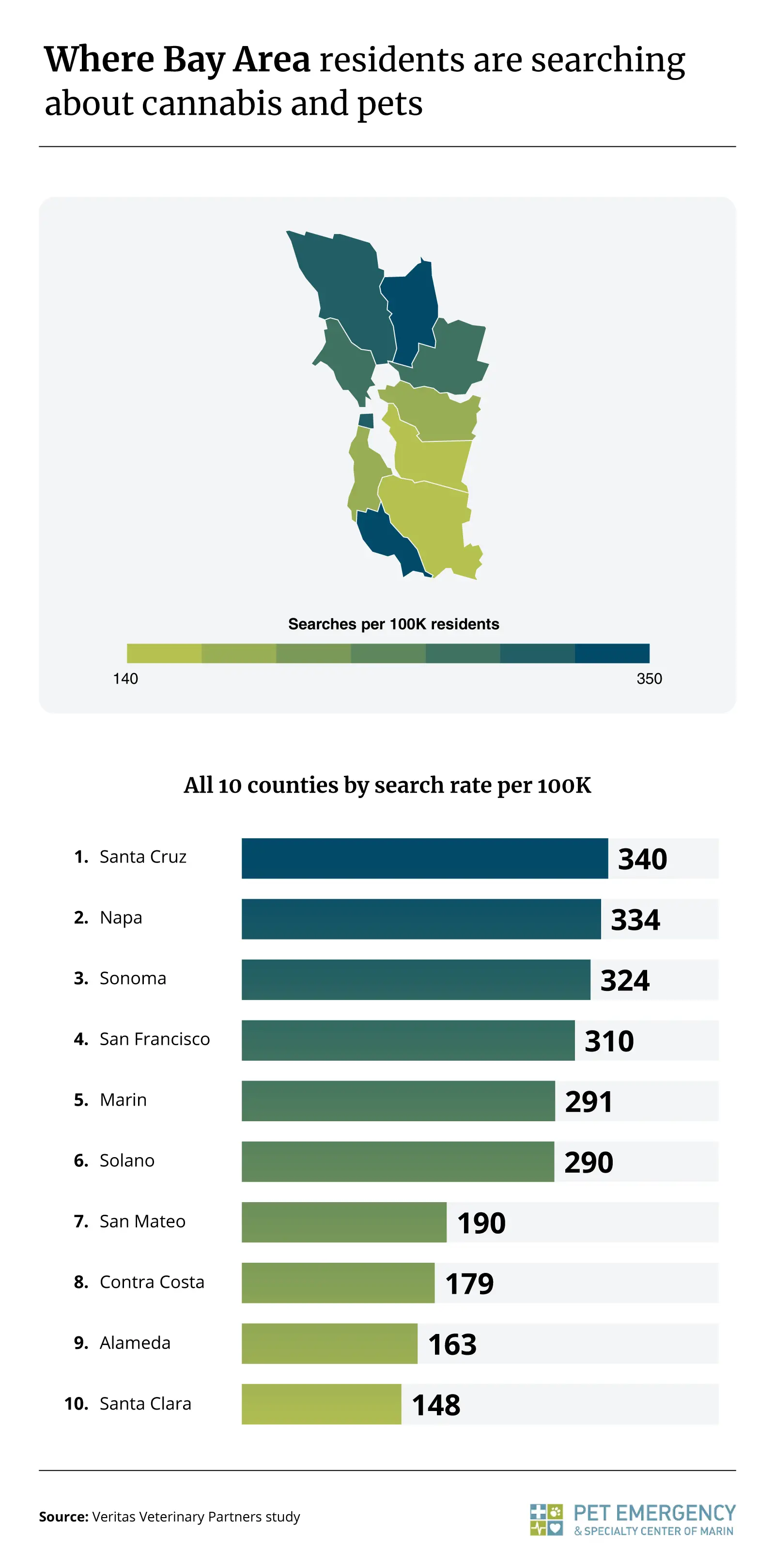
Santa Cruz County recorded the highest rate of cannabis-related pet searches at 340 per 100,000 residents, followed closely by Napa (334) and Sonoma (324). These wine-country and coastal regions led the Bay Area in per-capita search activity, suggesting a heightened level of concern relative to population size.
By contrast, more populous counties such as Santa Clara (148) and Alameda (163) showed the lowest search rates. The 2.3x gap between the highest and lowest county mirrors the national pattern of smaller populations showing higher per-capita search intensity.
San Francisco stood out as an exception, ranking fourth overall at 310 searches per 100,000 residents despite being the most urban county in the region. Marin County, home to PESCM, ranked fifth at 291 per 100,000, placing it within the upper tier of regional concern.
Across all 10 counties analyzed, search volume declined year over year, with decreases ranging from -9.6% in Marin to -27.6% in Solano. While fewer searches may suggest growing familiarity, it may also indicate that pet owners are turning to other sources for guidance.
How exposure happens and how owners respond
Cannabis exposure in pets is often rooted in routine behaviors rather than unusual events.
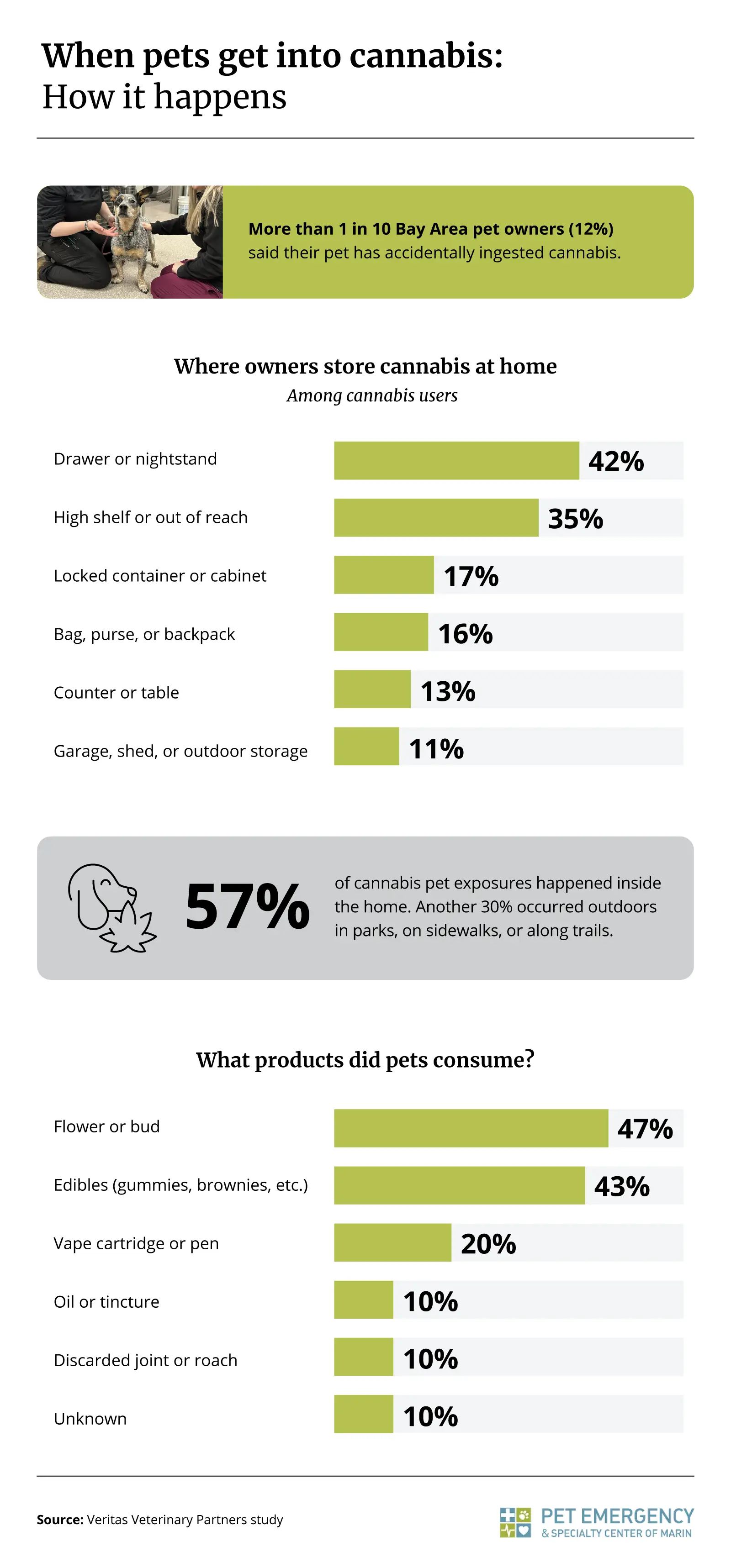
Twelve percent of Bay Area pet owners reported that their pet has ingested cannabis, a rate notably higher than the national benchmark of 8%. Storage habits played a central role, with 42% of cannabis users keeping products in drawers or nightstands and 35% relying on high shelves. Only 17% reported using a locked container.
Product type also shaped exposure patterns. Flower and bud accounted for 47% of incidents, followed by edibles (43%) and vape cartridges or pens. This contrasts with national trends, where edibles are the leading source of pet cannabis ingestion.
Most incidents occurred inside the home (57%). However, 30% took place outdoors in parks, sidewalks, and trails, highlighting the added risk of discarded cannabis products in public spaces.
Bay Area pet owners tend to act quickly, but their decisions still reflect a mix of urgency and uncertainty.
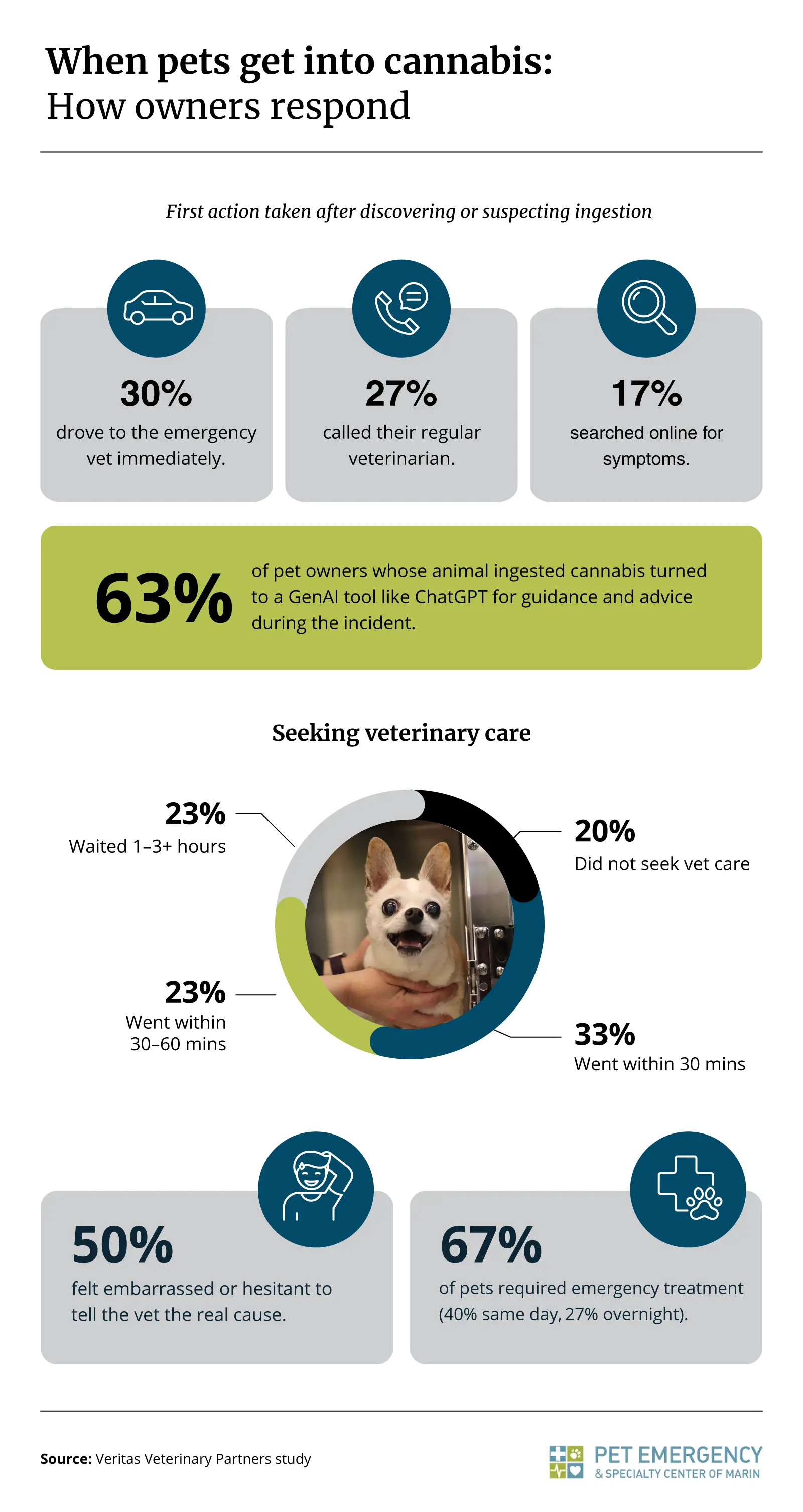
Thirty percent of owners reported driving to an emergency veterinarian immediately, while 27% contacted their regular veterinarian, both rates exceeding national averages. At the same time, 63% turned to generative AI tools for guidance, suggesting that even proactive owners are seeking immediate, accessible answers in high-stress moments.
Only 20% of owners reported never seeking veterinary care, a lower rate than the national average of 36%. But hesitation remains a factor. Half of those who visited a veterinarian said they felt embarrassed to disclose the true cause of their pet's symptoms.
Clinical outcomes underscore the seriousness of these exposures. Sixty-seven percent of pets required emergency treatment, compared to 52% nationally. The average cost of care reached $185. And while Bay Area pet owners show higher awareness than the national average, important knowledge gaps persist. Following these experiences, 27% of cannabis-using Bay Area pet owners reported quitting cannabis entirely.
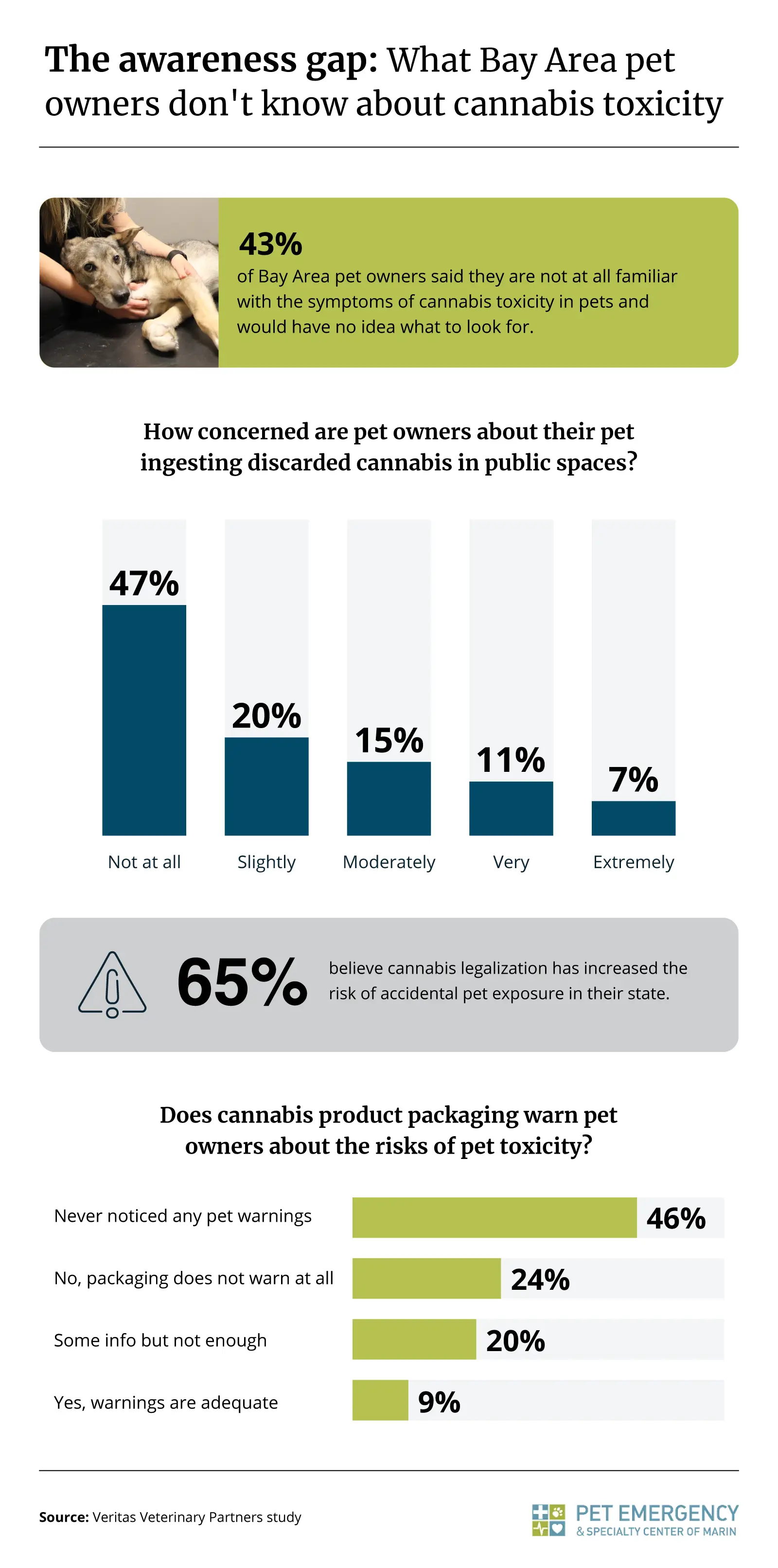
Forty-three percent of pet owners reported no familiarity with cannabis toxicity symptoms, while 12% said they were very familiar, an improvement over national figures, but still leaving many without the ability to recognize early warning signs.
Concern about exposure in public spaces was also higher locally, with 33% expressing moderate or greater concern compared to 22% nationally. This heightened awareness may reflect the visibility of cannabis use across the region.
A majority of residents (65%) believed legalization has increased the risk of pet exposure, a 19-point difference from national sentiment. Additionally, most pet owners (91%) said cannabis packaging does not adequately warn about pet toxicity risks.
Behavioral changes suggest growing awareness, with 46% of cannabis users saying they have adjusted storage practices proactively. Another 11% did so after an incident. Still, 35% reported making no changes, leaving a significant portion of pets at continued risk.
A modern risk in a modern home
For Bay Area pet owners, the risks tied to cannabis exposure are closer to home than most realize. The data shows a community that is engaged and willing to act, but still caught off guard when it matters most. Knowing the signs of cannabis toxicity, storing products securely, and having a plan before an emergency happens are the small steps that make the biggest difference when time is short and the stakes are high.
Methodology
For this study, we leveraged two different data sources. First, we analyzed cannabis-pet-related search volume across the U.S. to identify which counties searched most for these queries. Some of these queries included: "dog ate weed," "is thc toxic to dogs," and "is CBD safe for dogs," among many others. We analyzed search volume from April 2025 through March 2026, and the year before (April 2024 to March 2025) as a comparison.
Then, we conducted a survey of 248 California pet owners (including 50 Marin County and SF Bay Area residents) to ask about their experiences with cannabis-related pet incidents and how they responded.
About Pet Emergency & Specialty Center of Marin
Pet Emergency & Specialty Center of Marin is a 24/7 emergency and specialty veterinary hospital, providing advanced, collaborative care around the clock in the Bay Area. Our board-certified specialists and emergency clinicians work together across disciplines to deliver the highest level of medicine for pets facing complex or urgent medical situations. If you ever face a pet emergency, we're here to help.
Fair use statement
This content is free to share for noncommercial purposes. We just ask that you credit Pet Emergency & Specialty Center of Marin and link back to us when doing so.
The information contained in the article is for informational purposes only and is not intended to take the place of the advice of a veterinarian.